Posts

Showing posts with the label biasing

Class AB BJT biasing, diodes

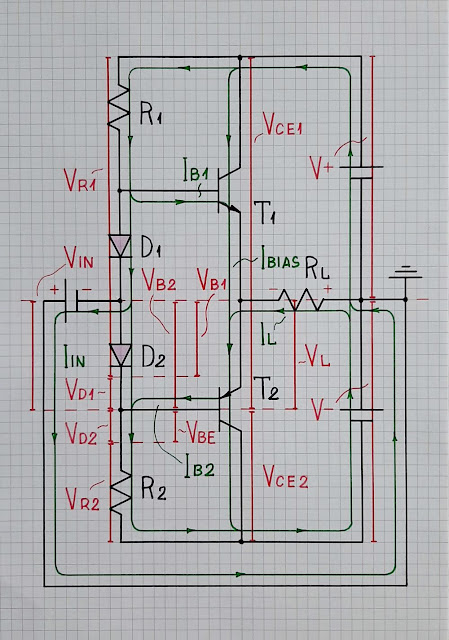
 This is  my answer  to SE EE question Class AB BJT biasing, diodes . My answer OP: "The voltage between the bases of transistors is highly dependent on the value of the resistors, even if both resistors are of the same value." This is actually the case when the input voltage applied to the midpoint between the diodes approaches the supply rails (large input signal). The problem of static quantities Static resistance. The problem can be that the resistors R1 and R2 have "static" (constant) resistance. And since the voltage applied across them varies considerably, the current through them varies and this causes the voltage across the diodes to vary as well. Static voltage. But the problem can be that the supply voltage Vcc is "static" (constant). And since the middle voltage Vmid considerably varies, the difference Vcc - Vmid = VR1 varies. This causes the current and eventually, the voltage across diodes to vary as well. The magic of dynamic quantities Dy...
Class AB power amplifier from "Electronic Devices" by Thomas L. Floyd

Image
This is  my answer  to SE EE question  Class AB power amplifier from "Electronic Devices" by Thomas L. Floyd . My answer Imagination is more important than knowledge. A. Einstein. How do we visualize the circuit operation? The notion of voltage as height is the most common idea of this electrical quantity (which is why we say "high" and "low" and not "big" and "small" voltage). It originates from the gravitational or "water tower" analogy where the height of a water column is proportional to the potential energy of the water. According to this approach, we can explain this circuit "geometrically" by imagining voltages as vertical segments ( voltage bars ) with a height proportional to the voltage value. It is well known that diodes maintain (approximately) constant voltage at their terminals (see this  intuitive explanation ). So, the voltage drops across them can be represented by segments of constant length (0.7 un...