Posts

Showing posts with the label online learning

What are voltages inside resistors?

Image
See also a related RG discussion and Codidact paper . By the mid-1990s, I had already developed my own philosophy about electronic circuits, and I decided it was time to share it with my colleagues. In the spring of 1997, I presented a series of three papers at the XXXII Scientific Conference on Communication, Electronic and Computer Systems at the Technical University of Sofia. The second of these was dedicated to my idea of visualizing circuit operation through interactive voltage diagrams . In this post, I will tell you about this venture of mine. Need to visualize voltage distribution Once visualized the voltages of the internal circuit points , we can go even further and "enter" inside resistors to visualize the voltages across the resistive film. This will allow us to see some interesting points (for example, virtual ground ), the operation of well-known electrical devices (potentiometer, resistive summer) and electronic circuits (inverting, non-inverting, differentia...
What are voltages in circuits?

Image
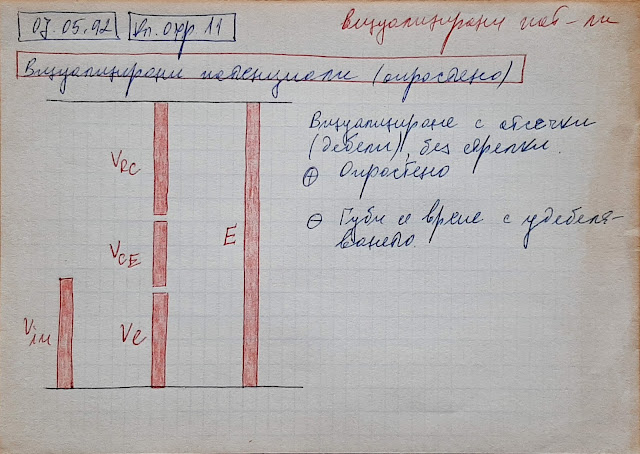
See also a related RG discussion and Codidact paper . By the mid-1990s, I had already developed my own philosophy about electronic circuits, and I decided it was time to share it with my colleagues. In the spring of 1997, I presented a series of three papers at the XXXII Scientific Conference on Communication, Electronic and Computer Systems at the Technical University of Sofia.  The first of these was devoted to my heuristic course on analog circuits , in which I had implemented my circuit philosophy. There I shared  my idea of visualizing circuit operation through interactive voltage bars . In this post I will tell you about this venture of mine. Need to Visualize Voltages I hope I have convinced you that a powerful technique for explaining circuits in an intuitive way is to show where currents flow . But since currents are created by voltages, it is even more important to show what voltages of the internal circuit points are. First Ideas Voltages, like currents, are invis...

Where do currents flow in circuits?

Image
I dedicate this story to my students from group 48a (see also a related RG discussion  and Codidact paper ) Need to visualize currents I have long understood that one of the most important techniques to understand circuits is to see where currents flow inside them (in circuit theory, this is considered unimportant and, at best, currents are represented by small arrows with arbitrary direction). First ideas The problem is that currents, like other electrical quantities, are invisible... and to show them, we have to visualize their paths, directions and magnitudes. That is why, in the late 80's , for the purposes of true understanding, I began representing current paths on circuit diagrams through closed directed lines. An example is the circuit diagram of an op-amp inverting amplifier from my Student Manual for the Analog Circuitry (1989): Another electrical "law" Even then, I realized how important is to draw power supplies because currents start from the positive termina...