Posts

Showing posts with the label diode

Calculate V for given circuit
Image
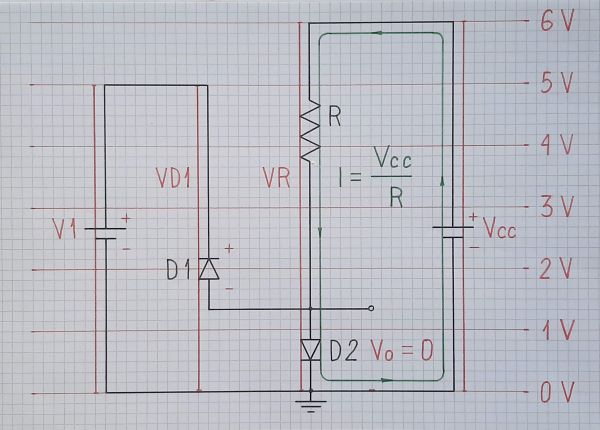
 This is my answer to SE EE question Calculate V for given circuit . My answer I further developed jonk's idea of a "geometric drawing" of the circuit diagram that would help find the answer... Step 1. The idea of this representation - Fig. 1, comes from the geometric notion of voltage, which is based on the analogy called "water tower". According to this idea, we represent the positive voltages and the parts of the circuit with such voltages above the zero reference level (ground) and the negative ones - below it. We can go even further by drawing diagrams in proportion to voltages using a certain scale factor V/unit. Fig. 1. A circuit with real diodes For this purpose, I accompany these "geometric-driven circuit diagrams" with a more stylized representation of voltages through vertical sections with proportional height, which I call voltage bars . Sometimes I mark voltage levels with thin red lines (as in Fig. 1); usually, it is sufficient to show ...
How does a diode maintain a constant voltage?

Image
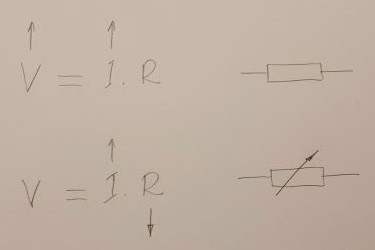
A fundamental property of all types of diodes (silicon, germanium, Schottky, LEDs, Zener ...) is to maintain a relatively constant voltage when the current through them varies. How do they do that? This question can be answered specifically by considering the processes in the semiconductor PN junction. Also, it would be interesting to explain this on a conceptual level by revealing the basic idea. This "philosophical" approach has several advantages: first, it does not require in-depth knowledge of semiconductor devices; second, it would be applicable to all 2-terminal devices that have this property. I will do this using the concept of "dynamic resistance". In the most general sense, a diode behaves like a resistor that interferes with current creating a voltage drop and heat loss. In the initial sloping part of its IV curve, this "resistor" has a relatively constant high resistance. And if it was really a resistor, the curve would continue in the same di...